The Carriage Roads
Forty-five miles of broken stone with no cars on them, seventeen stone bridges, and granite guardrails the locals call Rockefeller’s teeth. One man spent twenty-seven years building this.
A private road network, given away.
It is the best thing to do in Acadia that almost nobody plans for. Forty-five miles of gravel, graded so gently a horse could pull a carriage up it, winding past seventeen stone bridges with no engine noise anywhere.
John D. Rockefeller Jr. built 45 miles of carriage road across Mount Desert Island between 1913 and 1940, then gave them to the park. They are crushed stone, about sixteen feet wide, and closed to motor vehicles.
Walkers, cyclists and horse-drawn carriages share them. Dogs are welcome on all 45 miles, leashed — which in a national park is remarkable.
No reservation, no fee beyond park entry, and the Island Explorer’s Bicycle Express will carry you and a bike to the Eagle Lake entrance.
Built Like a Road, Not a Path
Twenty-seven years, three layers of rock, and granite quarried on the island
These are not trails that got widened. They were engineered, by people Rockefeller hired to do it properly, and the construction is the reason they still ride well a century later.
Three layers of rock, sixteen feet wide
Road crews quarried island granite for the material rather than hauling it in. The surface is broken stone laid in three layers, which is why it drains and holds rather than rutting.
A six-to-eight-inch crown
The roads are deliberately domed across their width so water runs off. It is invisible when you are on one and it is the single reason they survive Maine winters.
Graded for horses, which is why they are pleasant
Every gradient and curve was set so a horse-drawn carriage could take it comfortably — never too steep, never too sharp. That constraint is why a 45-mile gravel network feels gentle on a bike instead of brutal.
Rockefeller’s teeth
Large coping stones line the edges as guardrails, set at irregular heights. They are affectionately known as “Rockefeller’s teeth,” and once you have been told that you cannot unsee it.
Walls built to save the trees
Rather than cutting and flattening, the builders used retaining and breast walls to hold hillsides in place and leave what was growing there. It is the opposite of how a road usually gets made.
📍 Seventeen stone bridges, and Rockefeller paid for sixteen
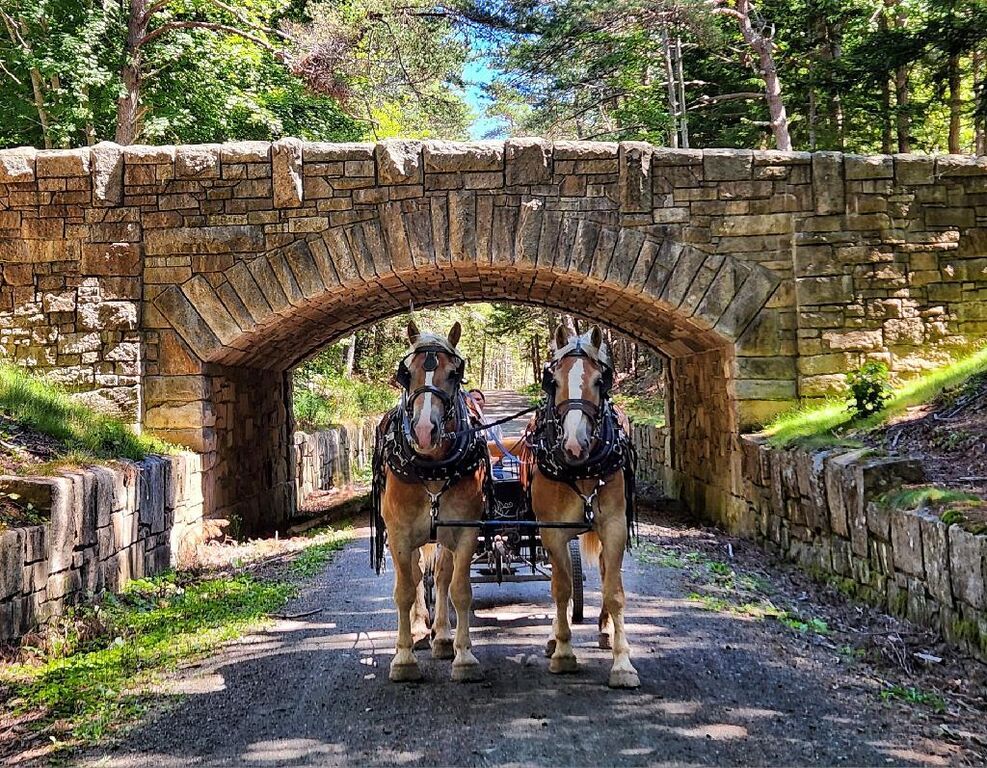
Each one is different, faced in stone, designed by architects he brought in for the purpose. Finding them is reason enough to ride.
There are also two gate lodges, at Jordan Pond and near Northeast Harbor. A third was planned for Eagle Lake and never built.
Rules, Rentals and Where to Start
Three rules, and only one of them is about speed
20 mph maximum for bicycles. Not a suggestion — it is the posted limit.
Everyone yields to horses, and cyclists yield to everyone. That is the park’s exact hierarchy. Horse-drawn carriages still use these roads, which is what they were built for, and meeting one coming the other way is the whole charm of the thing.
Dogs on a leash no longer than six feet, anywhere on the network.
Bikes: bring your own or rent from outfitters in Bar Harbor and around the island — the park does not rent them. A hybrid or mountain bike is happier than a road bike on crushed stone.
Getting there without a car: the Island Explorer’s Bicycle Express van runs between downtown Bar Harbor and the Eagle Lake carriage road entrance with a bike trailer. Eagle Lake is the usual first loop and a sensible place to start.
One catch: the Bicycle Express trailer does not carry dogs. Bike and dog in one trip is two trips.
Mud season closes them, usually March and April
The carriage roads often close to all traffic during spring mud season, when the frost comes out of the ground and the surface turns soft. Riding or walking them in that state does real damage to a surface built in 1920.
The exact closure moves every year and there is no published reopening date. In 2025 it began on March 18 and held until conditions dried and hardened. Check current conditions before planning a spring ride — and if they are closed, take it seriously rather than personally.
This Is the Dog-Friendly Half of Acadia
All 45 miles, plus 100 miles of hiking trail
Most national parks ban dogs from essentially everything. Acadia permits them on 100 miles of hiking trails and all 45 miles of carriage road, which makes it one of the genuinely dog-friendly parks in the system.
If you have arrived with a dog and discovered how little most parks allow, this network is the answer — car-free, gently graded, and open to you both for its entire length.
Federal law sets the leash at six feet, retractables included.
Practical Notes
- No reservation and no separate fee — a park entrance pass covers the carriage roads.
- Motor vehicles are prohibited. Other power-driven mobility devices need a special use permit from park headquarters.
- Human-powered mobility devices are welcome provided they stay under 20 mph.
- The surface is crushed stone, not pavement — fine tyres and thin road bikes will not enjoy it.
- Carriage rides are a separate commercial operation, not run by the park.
- Some carriage roads lie outside park boundaries on private land, where rules can differ. Signage marks the change.
Carriage Roads FAQ
How many miles of carriage roads are there in Acadia?
Forty-five miles, all closed to motor vehicles. They were the gift of John D. Rockefeller Jr. and family, built between 1913 and 1940.
Can you bike the carriage roads in Acadia?
Yes. All 45 miles are open to bicycles, with a 20 mph limit. The surface is crushed stone, so a hybrid or mountain bike suits it better than a road bike. Rent from outfitters around the island — the park itself does not rent bikes.
Are dogs allowed on the Acadia carriage roads?
Yes, on all 45 miles, on a leash no longer than six feet. Combined with 100 miles of pet-friendly hiking trail, it makes Acadia unusually dog-friendly for a national park.
Who has right of way on the carriage roads?
Everyone yields to horses, and bicyclists yield to everyone. Horse-drawn carriages still use the roads, which is what they were built for.
How many stone bridges are on the carriage roads?
Seventeen stone-faced bridges, sixteen of which Rockefeller financed. Each was individually designed. There are also two gate lodges, at Jordan Pond and near Northeast Harbor; a third planned for Eagle Lake was never built.
When are the carriage roads closed?
They often close during spring mud season, typically March and April, when the surface softens and is easily damaged. The dates move every year and no reopening date is published in advance — in 2025 the closure began March 18 and held until conditions dried.
Why are they called Rockefeller’s teeth?
The large coping stones set along the road edges as guardrails, at irregular heights, are affectionately known as Rockefeller’s teeth.
Can I get to the carriage roads without a car?
Yes. The Island Explorer’s Bicycle Express van runs between downtown Bar Harbor and the Eagle Lake carriage road entrance with a bike trailer. The trailer does not carry dogs.
Planning the rest of the trip?
The 3-day Acadia itinerary — where a carriage road ride fits, plus a free printable PDF and the map.
The best hikes in Acadia — including which trails take dogs.
The Park Loop Road and the shuttle — getting around, with or without a car.