3 Days in Acadia
A sand beach wedged into pink granite, forty-five miles of car-free gravel, and an island you can walk to across the sea floor. Plus the famous sunrise claim that is only true five months a year — which nobody tells you before you set the alarm.
Cadillac is the first sunrise in the country. For five months a year.
Everyone knows Cadillac Mountain is where the sun first touches the United States. Almost nobody knows the park attaches a date range to it.
Here is the National Park Service, on its own Cadillac Mountain page, in full: “From October 7 to March 6, Cadillac Mountain is the first place in the country you can see the sun rise.”
Now put that next to the other date range that governs this mountain — the season when you are allowed to drive up it.
The window NPS actually states. Outside it, the first sunrise in the country lands somewhere else — and for much of the year, somewhere else in Maine.
When a vehicle reservation is required — and therefore, broadly, when the summit road is open to drive for sunrise at all.
So for essentially the whole season when people are setting 3 AM alarms and refreshing Recreation.gov for a sunrise reservation, Cadillac is not the first place in the country to see the sun come up. It is still a magnificent sunrise. It is just not that sunrise.
The loop, the mountain, then your choice.
Acadia is small enough to feel generous. In three days you can stand on a summit above the clouds, walk out to an island on the sea floor, and ride forty-five miles of gravel road that has never had a car on it — without driving more than twenty minutes between any of them.
Day one is the Park Loop Road — Sand Beach, Thunder Hole, the Ocean Path and Jordan Pond. No reservation needed, but the parking fills by 9 AM.
Day two is Cadillac Mountain and the carriage roads. This is the day that needs the reservation, and the day most likely to be rearranged by one you couldn’t get.
Day three is yours: an iron rung climb, the quiet west side, the mainland at Schoodic, or forty-five miles of car-free gravel on a bike.
Three days is our call, not the park’s. And the reason isn’t size — Acadia is small. It’s that almost nothing here runs on your schedule. A reservation you might not get, a tide that moves an hour every day, a shuttle with a season, and parking that’s gone before breakfast. Any one of them can eat a morning.
📍 The reservation is not your park pass — and it isn’t a parking space
Three separate things, and people routinely think they’ve bought one when they’ve bought another.
The entrance pass gets you into Acadia — $35 for a private vehicle, valid seven days. The vehicle reservation is $6, sold only on Recreation.gov, and covers nothing except driving up Cadillac Summit Road. It is worth being very clear about the last one: the park says plainly that a reservation does not assign you a parking space. You have bought permission to drive up a road, nothing more.
And a reservation buys access, not a sunrise. Fog is common here in June, July and August, and it does not care that you booked ninety days ago.
Acadia Runs on the Tide, Not the Clock
The one thing that makes this itinerary different from every other one we publish
Most park itineraries are a schedule. This one can’t be, and it’s worth understanding why before you read the days below — it is the single thing that separates people who have a good time here from people who spend three days faintly puzzled.
Low tide moves roughly an hour later each day. So the best thing to do at 2 PM on a Tuesday is the wrong thing to do at 2 PM on a Wednesday. Three of Acadia’s signature experiences are gated by the tide, and no itinerary written in advance can tell you when to do them.
What we can tell you is the rule for each one, so you can look up a single number — the day’s low tide — and build around it.
A gravel bar from downtown Bar Harbor to an island, exposed for about three hours twice a day. Miss your return and it is nine hours before the bar is safe to walk again — the park’s figure, not a scare story.
Bar Island — about three hours, twice a day
1.9 miles round trip from the bottom of Bridge Street in Bar Harbor. You walk out across the sea floor to an island, past boats sitting on mud that was ocean an hour ago. It is the best free thing in Acadia and it does not feel like a national park at all — it feels like you are getting away with something.
People genuinely get stranded here. Not many, but every season. Set your alarm for the turnaround, not the start — the island is small enough that you will think you have longer than you do.
Thunder Hole — 1 to 2 hours before high tide
Opposite end of the tide cycle from Bar Island, and the reason most people come away unimpressed. Turn up at the wrong hour and Thunder Hole is a wet crack in some granite with forty people photographing it.
The boom needs one to two hours before high tide and some weather behind it. Get both and the ground moves. Get neither and no amount of standing there will fix it, which is worth knowing before you build a detour around it.
Tidepooling — the same window as Bar Island
Same 1.5 hours either side of low tide, which means tidepooling and Bar Island are competing for exactly the same slot. One per low tide. Choose.
How to actually do this: look up the day’s tide chart for Bar Harbor the night before. If low tide falls in daylight, that’s your Bar Island morning or afternoon, whichever day it lands on. If high tide falls in daylight, that’s your Thunder Hole. Everything else in this itinerary can move around them.
Bar Island is the only stop in this guide we have not assigned to a day. It belongs to a tide, not to a Tuesday.”
The Park Loop Road
Twenty-seven miles, and nearly everything you came to photograph
Sleep: Bar Harbor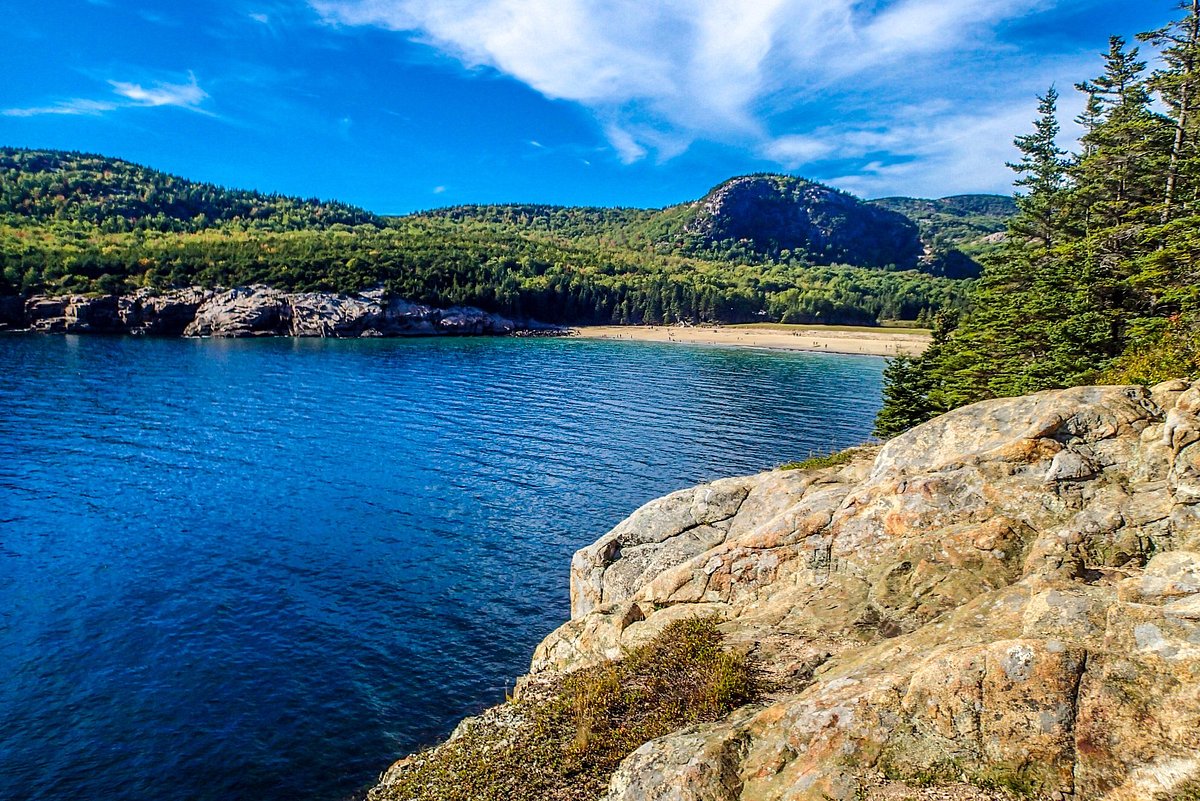
This is the day that sells the park: a beach, a hundred-foot cliff and a glacial pond, all within half an hour of each other. No vehicle reservation today — that’s Cadillac only. What you need is an early start. Sand Beach and the right-hand lane toward Otter Point are routinely full by 9 AM in summer and at weekends, and because most of the loop is one-way, overshooting a parking area means driving the whole thing again before you get another go at it. Set off earlier than feels necessary.
Hulls Cove Visitor Center
Start here for the park map and the current tide chart. Pick up your entrance pass if you haven’t bought it online — and note that Acadia is cashless, so bring a card.
Sand Beach
A sand beach in a granite park, tucked into Newport Cove behind the arm of Great Head. Park here before 9 AM or accept that you won’t.
The water is colder than it looks. At its warmest, in August, it is 55 to 60°F. People go in. People do not stay in. Lifeguards are on duty seasonally, and dogs are off the beach through the summer months.
Great Head Loop
1.9 miles, or a shorter 1.3-mile option. 1–2 hours. Starts at the far end of Sand Beach, up a steep staircase covered in sand. The longer loop includes a rocky scramble where you’ll need your hands.
Stay off the edge. Waves here run three to five feet and higher, and the park’s own wording is the line worth carrying around with you: “Never turn your back to the ocean.” It sounds dramatic until you watch someone frame a photo with their heels to the water.
The Ocean Path to Otter Point
2.2 miles one way, 4.4 round trip. 2–4 hours. Gravelly and rocky with uneven surfaces, and two staircases about 1.4 miles in. Most people walk out to Otter Point and turn back.
You pass Thunder Hole, then Otter Cliffs — 110 feet, the highest point on the trail — then the granite slabs at Otter Point. Walk it one way and catch the Island Explorer back if the bus is running.
Thunder Hole
It’s on the Ocean Path, so you’ll pass it regardless. Whether it performs is the tide’s decision, not yours — see the window above. If today’s high tide lands mid-afternoon, come back for it.
Jordan Pond Path
3.3-mile loop, 1–3 hours. Forested, with uneven footing on boardwalks, rocks and footbridges, and the Bubbles sitting at the far end of the water looking exactly like the postcard.
Worth knowing before you commit: the western half is significantly harder than the eastern half. The flat boardwalk at the start lulls you. Walking the east shore out and back is a perfectly respectable day and most people would enjoy it more.
Jordan Pond House
Tea and popovers on the lawn, looking up the pond at the Bubbles. It is the most touristed thing in the park and it is also genuinely lovely. Seasonal — check it’s open before building an afternoon around it.
Park at a Park & Ride and take the Island Explorer, which is fare-free and serves Sand Beach, the Ocean Path and Jordan Pond. This is the single best reason to visit between late June and mid-October — outside the shuttle season, a full lot means you drive the loop again.
Cadillac Mountain and the Carriage Roads
The reservation day — and forty-five miles of gravel with no cars on it
Sleep: Bar Harbor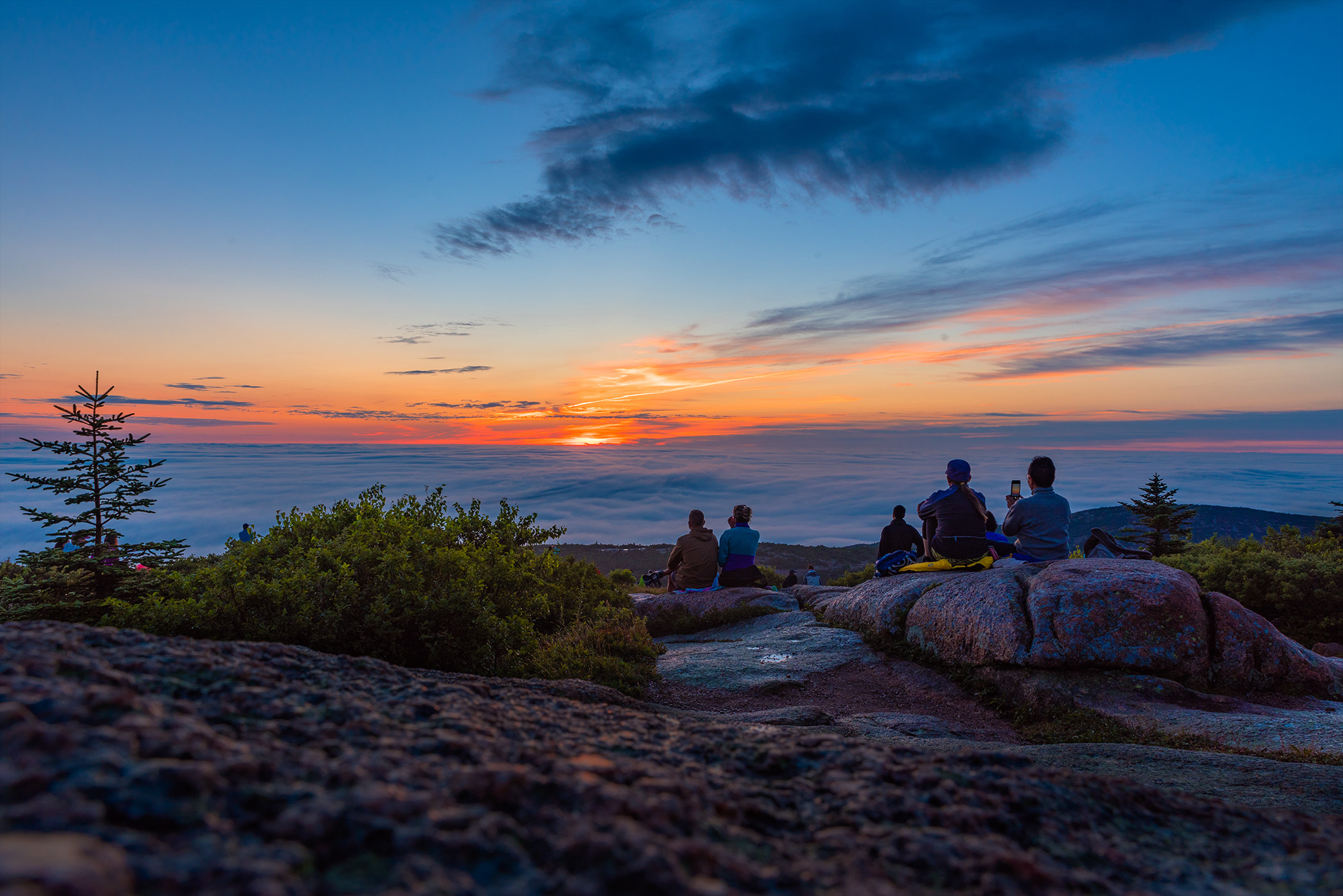
Today is built around a $6 vehicle reservation you booked on Recreation.gov — 90 days out, or in the two-day release. If you didn’t get one, don’t move this day; read the section further down and swap the summit for one of the ways up that need no reservation at all.
sunrise
Cadillac Summit Road
Go up about an hour before sunrise. The parking is often full at sunrise and sunset, and your reservation is an entry window, not a seat — which is the gap most people fall through.
The summit is only 1,530 feet, strikingly low for the reputation, and that is part of why it works: the ocean starts more or less at the bottom of the hill. There is no re-entry, so go up once and stay up.
The thing itself
Cold, windy, exposed, and busier than any photograph of it suggests. Whatever the forecast says, the summit is colder and the wind is doing something the forecast did not mention. Bring the extra layer you think you won’t need, and gloves further into the season than feels reasonable.
If you’re here between October 7 and March 6, this genuinely is the first sunrise in the country. The rest of the year it’s a beautiful sunrise from a low granite summit over the Gulf of Maine, which is reason enough.
Back down, and breakfast in Bar Harbor
You’ve been up since four. Take the morning back.
The carriage roads by bike
Forty-five miles of broken-stone road with no cars on them, paid for and fussed over by John D. Rockefeller Jr. between 1913 and 1940. The surface is crushed stone, not pavement, so a hybrid or a rented mountain bike is happier than a road bike. Eagle Lake is the usual first loop, and the Bicycle Express van will take you and the bike there from downtown Bar Harbor.
Rules that matter: 20 mph, everyone yields to horses, cyclists yield to walkers. Horse-drawn carriages still use these roads — that is what they were built for, and meeting one coming the other way is the whole charm of the thing.
Bar Island, if the tide cooperates
If today’s low tide falls in daylight, this is where it goes. If it doesn’t, move it — to day one, day three, or an evening. See the window above.
Bar Harbor
Walk the Shore Path, eat, and look at tomorrow’s tide chart before bed.
A small thing that ruins a plan. The Island Explorer’s Bicycle Express carries bikes between Bar Harbor and Eagle Lake, but the trailer does not carry dogs.
Choose Your Adventure
Four genuinely different days, depending on the trip you’re having
Sleep: Bar Harbor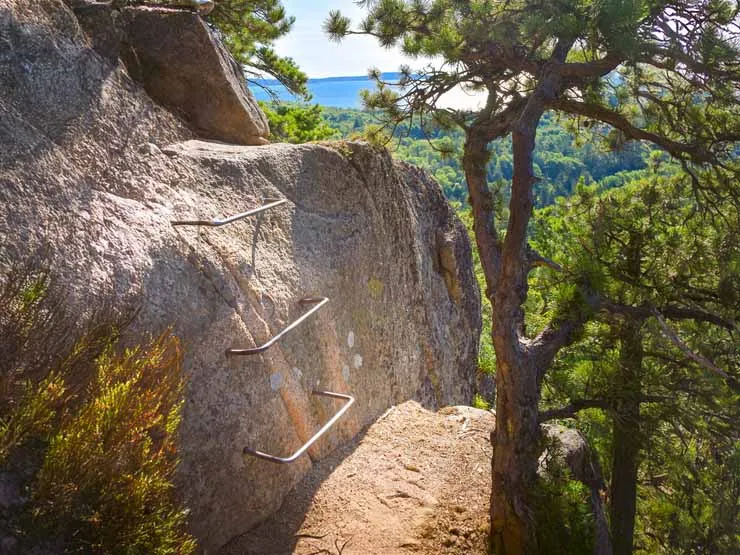
Day three exists so the trip isn’t a forced march, and so a missed reservation or a tide that landed at midnight doesn’t cost you anything. Pick one.
Beehive Loop: 1.4 miles round trip, 1–3 hours. The first part ascends a 450-foot cliff with exposed edges, with iron rungs, sections where you walk across iron bars instead of ground, and ladders. Summit 520 feet.
Precipice Loop: 3.2 miles round trip, 2–3 hours, rising over 1,000 feet in 0.9 miles. This is the one where the park’s own wording earns its place, so here it is unedited: “not recommended for small children, for people with a fear of heights, or for anyone in wet weather,” and “descending the Precipice is dangerous and not advised.” You come down the North Ridge Trail instead — plan the loop, not an out-and-back.
Both close from March 1 for nesting peregrine falcons, with no reopening date published in advance. No pets on the rung trails. And wet granite here is genuinely treacherous — if it rained overnight, go and do something else and come back when the rock has dried.
The other half of Mount Desert Island, with a fraction of the people. Acadia Mountain and St. Sauveur, the working harbor at Southwest Harbor, and Bass Harbor Head Light at the southern tip. Half the island, almost none of the crowd.
Acadia’s only mainland section, about an hour by car from Hulls Cove, or by seasonal passenger ferry from Bar Harbor to Winter Harbor. Deliberately kept minimally developed and lightly visited — which is exactly why people who make the trip rate it so highly.
A genuine day, not a detour. Worth it on a third day; worth more on a fourth.
If day two’s ride was the best part of your trip, spend day three doing the rest of the carriage road network properly. It is the largest car-free road system of its kind in the country and there is no reason to ration it.
Not on this list, deliberately
Isle au Haut. Passenger ferry only, first-come first-served, with Duck Harbor served only from mid-June to late September and visitor numbers deliberately limited. It is a wonderful place and it is not a first-visit stop — it’s a day you build a trip around, not a day you slot into one.
A split stay. Mount Desert Island is not large enough to justify repacking a bag. Three nights, one hotel in Bar Harbor. Southwest Harbor is the quieter alternative if restaurants matter less to you than mornings do.
“I couldn’t get a Cadillac reservation. Can I still go up?”
Yes. Four ways, and two of them are better than driving
This is the most common panic in Acadia planning, and the answer is more generous than people assume. The reservation applies to vehicles on Cadillac Summit Road. It is not a permit to be on the mountain.
The two-day release
Only 30% of reservations go out 90 days ahead. The other 70% are released at 10 AM Eastern, two days before. If you missed the 90-day drop, you have not missed your chance — most of the inventory hasn’t been sold yet.
Walk up the North Ridge Trail
4.4 miles round trip, 2–4 hours, up granite slope and stairs. No reservation, no $6, and — said plainly — a far better morning than a car park at the top. You get the ridge to yourself while everyone else is queuing for a space, and you arrive having earned it. Start from the Cadillac North Ridge or Kebo Brook trailhead.
Or the South Ridge Trail, the long way
7.1 miles round trip, 2–4 hours, along a forested path onto open granite ridgeline with one iron rung. The trailhead is off Route 3 in Otter Creek just past Blackwoods Campground, with no road sign and shoulder parking only.
It is also the one route up the mountain where dogs are allowed — leashed, six feet, and mind the single iron rung on the way.
Bike or taxi
Neither needs a reservation. The road is narrow and you’ll be sharing it with cars, so this is a confident-cyclist option rather than a casual one.
What won’t work: waiting for a bus. The Island Explorer does not go up Cadillac — the free shuttle that solves your parking problem everywhere else in the park simply does not serve this one mountain. And unlike some parks, booking a campground doesn’t come with summit access either.
How the release actually works
30% at 10 AM Eastern, 90 days before. 70% at 10 AM Eastern, two days before. Sunrise and daytime are separate categories with separate inventory.
Two differences worth knowing: a sunrise reservation gives you a 90-minute entry window where daytime gives you 30, and you may hold one sunrise reservation per seven days, against one daytime reservation per day. Reservations control entry only — there’s no departure deadline until the road closes at 9 PM — and there is no re-entry.
Full detail is in our Cadillac reservations guide.
There is a $100 per person surcharge
From January 1, 2026, non-US residents aged 16 and over pay $100 per person on top of the standard entrance fee, unless admitted on a qualifying annual pass. It applies to non-residents in commercial tour groups as well.
For a family of four visiting from abroad, that is $400 before the $35 vehicle pass. A non-resident annual pass can cover the holder plus additional non-residents in qualifying circumstances, which changes the arithmetic quickly — price both before you arrive.
You Can Actually Do This Without a Car
Which is not true of most national parks, and is very true here
The Island Explorer is fare-free, propane-powered, and serves campgrounds, trailheads, carriage road entrances, the towns and the airport. You can flag one down anywhere it’s safe to stop. You still need an entrance pass.
Staying in Bar Harbor without a car is genuinely workable for a first visit: the shuttle reaches the Park Loop Road stops, Bar Island is a walk from downtown, and the Bicycle Express gets you and a bike to the carriage roads.
What you lose: west-side trailheads outside the frequent routes, Schoodic on a tight schedule, and everything after the shuttle season ends. The service is seasonal — in 2026 it ran seven days a week through October 13, with reduced autumn service from August 18.
And it does not go up Cadillac.
Practical Notes
- Acadia is cashless. The park moved to a fully cashless fee system in April 2025. If you only have cash, buy a pass from a third-party seller outside the park.
- Entrance fees: $35 private vehicle for seven days, $30 motorcycle, $20 per person on foot or bike. The Cadillac reservation is $6 and separate.
- Peregrine falcon closures begin March 1 on the rung and ladder trails, and reopen when the nesting allows — no date is published in advance. Check conditions before you plan a day around Precipice.
- The carriage roads close in mud season, typically March and April. In 2025 the closure started March 18 and held until the surface dried and hardened. No reopening date is published in advance.
- Park Loop Road is seasonal, opening around April 15. In winter only a limited section stays open to vehicles, broadly from the entrance station to Otter Cliff Road.
- Black flies are usually worst from mid-May to mid-June.
- Fog is common in June, July and August — which is worth weighing against a sunrise reservation booked 90 days out.
- Peak foliage is usually mid-October, with a range across roughly the first three weeks of the month.
- Campgrounds are the only lodging inside the park. Blackwoods, Seawall and Schoodic Woods release 90% of sites six months ahead on the first of each month at 10 AM Eastern, and the remaining 10% fourteen days ahead. All bookings are through Recreation.gov.
Acadia FAQ
Is Cadillac Mountain really the first place in the US to see the sunrise?
Only part of the year. The National Park Service states: “From October 7 to March 6, Cadillac Mountain is the first place in the country you can see the sun rise.” Outside that window the distinction moves elsewhere in Maine — West Quoddy Head and Mars Hill are the usual contenders, depending on the date.
NPS states Cadillac’s window but does not publish a day-by-day list naming who holds the title the rest of the year, so treat any source that gives you exact alternate date ranges with caution.
Do I need a reservation to visit Acadia National Park?
No. A vehicle reservation is required only to drive Cadillac Summit Road, from May 20 through October 25 in 2026. The rest of the park — the Park Loop Road, Sand Beach, Jordan Pond, the carriage roads, every trail — needs no reservation at any time.
You do need an entrance pass, which is a separate thing and separately priced.
How do I get a Cadillac sunrise reservation?
Recreation.gov, $6 per vehicle, and nowhere else — they are not sold at the park. 30% of inventory is released at 10 AM Eastern 90 days before your date, and the other 70% at 10 AM Eastern two days before. Sunrise reservations are limited to one per seven days.
If you miss both drops, you can still walk up. The North Ridge Trail is 4.4 miles round trip and needs no reservation.
Does the reservation guarantee me a parking space at the summit?
No, and NPS says so explicitly. The reservation controls entry to the road; it does not assign a space. Summit parking is often full at sunrise and sunset.
How long do I need in Acadia?
Three days for a first visit. Two covers the Park Loop Road and Cadillac and little else. The reason to give it three isn’t the size of the park — Acadia is compact — it’s that the reservation window, the tide table, the shuttle season and the parking all run on their own schedules, and any of them can cost you a morning.
Can I walk to Bar Island?
Yes, at low tide. The gravel bar is exposed from about 1.5 hours before to 1.5 hours after low tide — roughly a three-hour window — and the walk is 1.9 miles round trip from Bridge Street in Bar Harbor.
Miss the window and the park puts it at nine hours before the bar is safe to walk again. Set an alarm for your turnaround, not your start.
Why was Thunder Hole disappointing?
Almost certainly the tide. The famous sound needs one to two hours before high tide, with the right wind and waves behind it. At any other point in the cycle there is simply nothing to hear, and standing there longer will not change it.
Is the Beehive or the Precipice too scary?
They are iron rung and ladder climbs with steep drop-offs and no railings, not ordinary hikes. NPS says the Precipice is “not recommended for small children, for people with a fear of heights, or for anyone in wet weather,” and that descending it is dangerous and not advised — you return by a different trail.
The Beehive is shorter at 1.4 miles round trip, but it ascends a 450-foot cliff with exposed edges, includes stretches where you walk across iron bars rather than ground, and coming back down the rungs is not advised either. Both close from March 1 for nesting peregrine falcons. Wet granite here is genuinely treacherous — if it rained overnight, go elsewhere and come back when the rock has dried.
Is there a hotel inside Acadia National Park?
No. The only overnight accommodation inside the park is camping, at Blackwoods, Seawall, Schoodic Woods and the Duck Harbor shelters on Isle au Haut. Everyone else stays in Bar Harbor or the smaller harbor towns.
Can I do Acadia without a car?
More easily than almost any other major national park. The fare-free Island Explorer serves trailheads, carriage road entrances, campgrounds, the towns and the airport, and Bar Island is walkable from downtown Bar Harbor.
The limits are the west side, Schoodic on a tight schedule, and anything outside the shuttle season — and Cadillac, which the shuttle does not serve at all.
Three layers — Day 1 on the Park Loop Road, Day 2 on Cadillac and the carriage roads, Day 3 wherever you choose to spend it. Open it in Google Maps on your phone before you lose signal.
Planning the rest of the trip?
Cadillac Summit Road reservations, explained — the two categories, both release drops, and what to do when you miss them.
The best hikes in Acadia — real distances and durations, and the rung trails handled honestly.
Where to stay near Acadia — Bar Harbor and the quieter alternatives.